
Traffic Police Intensifies Crackdown on Tinted Glasses Amid Calls for Clearer Implementation

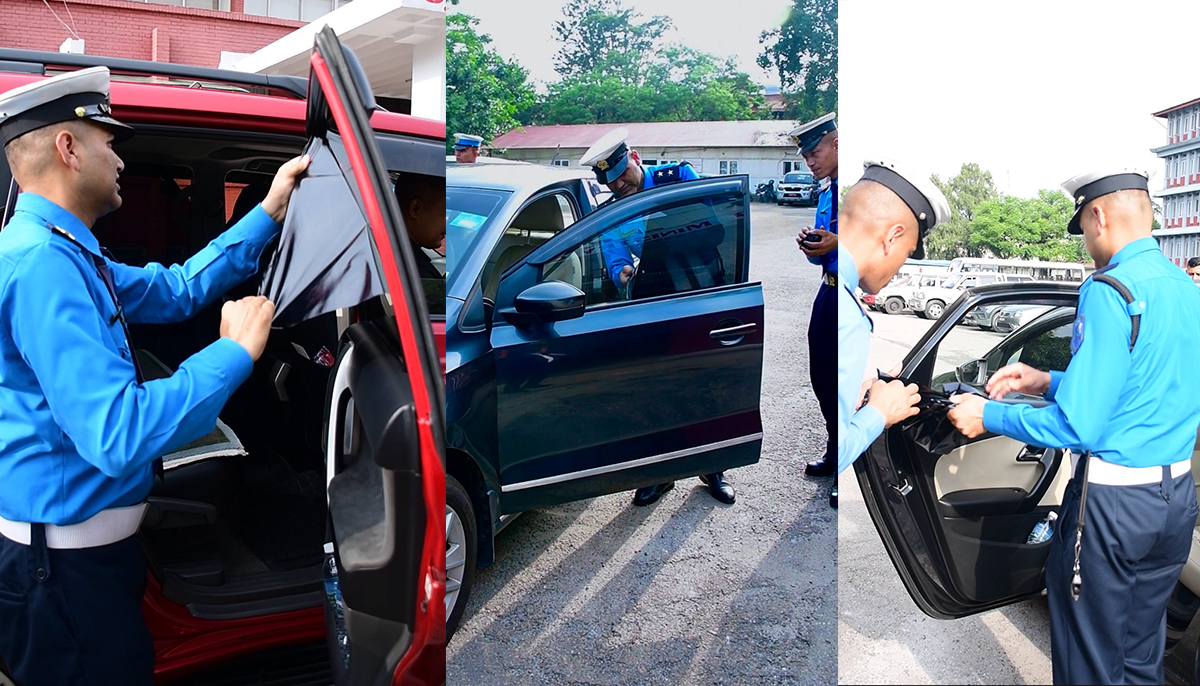
The Metropolitan Traffic Police Division has intensified its drive against vehicles fitted with tinted glasses, reigniting a long-running debate over road safety, privacy, and regulatory clarity in Nepal.
Traffic authorities say heavily tinted vehicles have increasingly been linked to various criminal activities, prompting stricter enforcement against unauthorized window tints across the Valley.
Citing provisions under the Vehicle and Transport Management Act, 2049, officials have stated that action against vehicles using illegal tinted glass will continue.

Authorities have also reiterated that existing regulations prohibit the use of dark films, stickers, or any material that obstructs visibility on a vehicle's front windshield. Vehicle owners wishing to use tinted glass are required to obtain prior government approval, while importers have been urged to inform customers about the prevailing legal provisions.
According to the existing legal framework, only the President and the Prime Minister are exempt from restrictions related to vehicle tinting.
All other VIPs and members of the general public are permitted to use tinted glass only after fulfilling conditions set out under Section 39 of the Vehicle and Transport Management Act, 2049, and Rule 12 of the Vehicle and Transport Management Regulations, 2054. The provision requires applicants to obtain approval by depositing a security amount and allows the use of tinted glass with a maximum tint level of up to 20 percent.
The issue was also discussed during a recent meeting between representatives of the NADA Automobiles Association of Nepal and officials from the Kathmandu Valley Traffic Police Office, where both sides stressed the need for a practical and phased implementation approach.
Industry representatives suggested that authorities should initially focus on removing aftermarket tint films and dark stickers, as these can be removed without major technical complications. They also noted that vehicles imported with factory-fitted privacy glass account for a relatively small share of the market and could be addressed separately through a dedicated mechanism.
The latest move marks yet another attempt by traffic authorities to regulate the use of tinted windows in Nepal, an issue that has resurfaced repeatedly over the years.
Safety and Security Benefits
Traffic police argue that limiting dark window tints enhances both public security and road safety. Greater visibility into vehicles enables law enforcement agencies to identify occupants more easily and can help deter the use of vehicles in criminal activities.
Authorities also maintain that reduced tinting improves visibility for drivers, particularly during nighttime driving and adverse weather conditions, thereby contributing to safer roads.
Globally, many countries regulate vehicle window tinting through Visible Light Transmission (VLT) standards rather than imposing outright bans.
In neighboring India, for instance, regulations require front and rear windshields to allow at least 70 percent visible light transmission, while side windows must permit a minimum of 50 percent. Nepal, however, does not currently have a clearly defined VLT-based standard.
Concerns Over Implementation
Despite the safety rationale, the renewed crackdown has raised concerns among vehicle owners and industry stakeholders.
One of the major issues is the absence of clear technical guidelines differentiating factory-fitted privacy glass from illegal aftermarket tint films. Many modern vehicles, particularly premium SUVs and electric vehicles, are imported with manufacturer-installed privacy glass designed to reduce cabin heat, block ultraviolet radiation, and improve passenger comfort.
Without specific standards on permissible tint levels, stakeholders argue that enforcement could become inconsistent, creating confusion among both motorists and traffic personnel.
Vehicle owners also point out that tinted windows offer several practical benefits in Nepal's climatic conditions, including lower cabin temperatures, protection from harmful UV rays, and enhanced privacy for passengers.
Proposed Rs 1 Lakh Fine Raises Questions
The debate has gained further attention as a proposed amendment to transport laws reportedly seeks to impose fines of up to Rs 1 lakh for the use of tinted glass beyond the "permitted standard."
However, critics have highlighted a key concern: while authorities are proposing stricter penalties, the government has yet to clearly define what the "permitted standard" actually is.
In the absence of measurable standards such as VLT limits or detailed technical specifications, many believe imposing hefty penalties could lead to confusion and arbitrary enforcement.
Netizens Demand Clarity
The intensified enforcement has also sparked widespread discussion on social media, with many netizens expressing support for stricter regulations in the interest of security while simultaneously calling for clearer and more transparent rules.
Several users have argued that authorities should clearly distinguish between factory-fitted privacy glass and aftermarket tint films rather than adopting a blanket enforcement approach. Others have questioned how motorists are expected to comply when specific tint standards have not been publicly defined.
Many have also called for the government to publish clear guidelines and ensure uniform implementation before imposing stricter penalties.
Need for a Comprehensive Framework
While the traffic police's security concerns are widely acknowledged, experts say Nepal now requires a comprehensive regulatory framework instead of periodic enforcement drives.
A clearly defined standard specifying permissible light transmission levels, coupled with a distinction between factory-fitted privacy glass and aftermarket films, would provide greater certainty for consumers, importers, and enforcement agencies alike.
As vehicle technology continues to evolve and premium vehicles become increasingly common on Nepali roads, striking a balance between public safety and consumer convenience will remain crucial.
For now, motorists in Kathmandu Valley are being advised to remove unauthorized tint films and ensure their vehicles comply with existing transport regulations to avoid enforcement action.

Omoda Jaecoo Continues Nepal Premier League Partnership for 2026
Same Same, But Different: MG and Wuling's EV Battle